
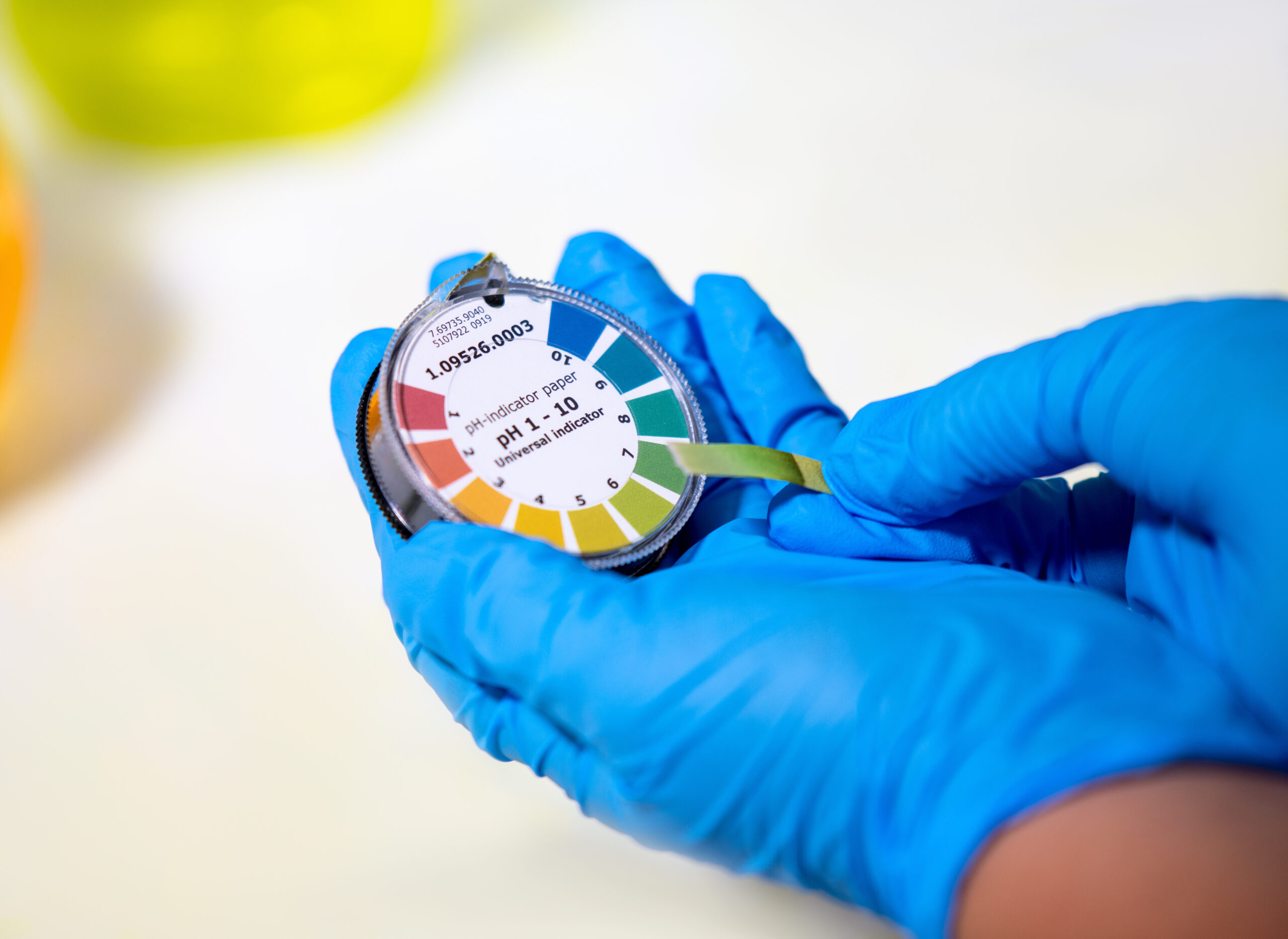
Nearly every industrial cleaning product describes itself using pH — neutral, alkaline, highly alkaline, acidic, caustic. Those words decide which soils a product will lift and which surfaces it can safely touch, and they are the single most useful thing on a technical data sheet. They are also almost never explained.
This guide fixes that. What pH actually measures, why it determines which soils release, how to read the number on a data sheet correctly, and how to match pH to both the soil and the surface. If you have ever wondered why a “highly alkaline” degreaser wrecked an aluminium housing while a higher-pH product did not, the answer is here.
It pairs with Cleaner vs. Degreaser vs. Disinfectant, which covers what the product categories are, and How to Choose the Right Industrial Degreaser for Your Facility, which covers how to select within one of them.
pH is a measure of how acidic or alkaline a water-based solution is, on a scale that runs from 0 to 14. Seven is neutral — pure water. Below seven is acidic. Above seven is alkaline, sometimes called basic.
The part that trips people up: the scale is logarithmic. Each whole number is a tenfold change. A solution at pH 12 is ten times more alkaline than one at pH 11 and a hundred times more alkaline than one at pH 10. This is why the gap between a pH 10.5 cleaner and a pH 13 degreaser is enormous in practice even though the numbers look close, and why “a bit stronger” is a misleading way to describe moving up the scale.
The second thing worth knowing is that pH only describes water-based solutions. It says nothing about solvents, and it is not a measure of how aggressive a product is on every material — a well-inhibited high-pH product can be gentler on aluminium than an uninhibited lower-pH one. More on that below, because it is the mistake that costs the most money.
This is the most common misreading of a technical data sheet, and it matters more than any other single point in this guide.
A published pH figure is only meaningful alongside the concentration it was measured at. Most industrial concentrates state pH in solution — commonly at 1% — not in the drum. So a product listed at “pH 13.0 in 1% solution” is at pH 13 after dilution, which means the concentrate itself is considerably more aggressive than that figure suggests.
Two practical consequences. First, comparing a concentrate pH against a ready-to-use pH tells you nothing. Second, and more importantly for your floors: if your crews mix strong, they are not just wasting product, they are moving the pH up the scale. A tank mixed at double the specified ratio is a materially different chemical from the one whose compatibility your supplier signed off on. That is the mechanism behind a large share of surface damage that gets blamed on the product.
Which is why pH and dilution control are the same conversation. Dilution Control Systems covers the equipment side.
Different soils are chemically different problems, and pH is what determines whether a given soil releases or sits there.
Alkalinity works on organic soils by breaking down fats and oils into components that water can carry away, and by loosening protein so it releases from a surface. This is why virtually every serious degreaser is alkaline, and why the heaviest grease work sits at the top of the scale.
Alkalinity also helps disperse soil so it stays suspended in the solution rather than redepositing — which is a large part of why an alkaline cleaner rinses a greasy floor cleanly while a neutral one can leave it looking smeared.
Acids dissolve inorganic soils: hard-water scale, lime, rust and corrosion, mineral film on stainless, efflorescence on masonry, and urine salts in restrooms. These are the soils alkaline chemistry cannot touch, which is why a facility that only stocks degreasers eventually ends up with a scale problem it cannot clean.
Acids are also the chemistry most likely to damage the wrong surface quickly — natural stone, some grouts, unsealed concrete and many metals all react. Compatibility matters more here than anywhere else on the scale.
Neutral cleaners work through surfactants rather than pH. They lift light soil, tracked-in dirt and general traffic film, and they are the right answer on finished floors, coated surfaces and anything where dulling, etching or stripping is a concern. Because they are not doing chemical work on the soil, they need more help from mechanical action and dwell time.
Most facilities should run a neutral product as the daily default and reserve alkaline chemistry for the zones that actually need it. That is both cheaper and easier on the floor.
The table below is the practical version of everything above. Find your soil in the left column.
| Soil | Chemistry that lifts it | Typical use-dilution pH | Why it works | Watch out for |
|---|---|---|---|---|
| Light traffic film, tracked-in dust, general maintenance soil | Neutral cleaner | ~7 | Surfactants lift and suspend light soil without chemical attack on the surface | Will not shift established grease; needs dwell and mechanical action |
| Food soils, light kitchen grease, general organic soil | Mildly to moderately alkaline | ~8–10 | Enough alkalinity to break down fats without stripping finishes | Rinse properly on food-contact surfaces |
| Heavy grease, oil, lubricants, road film, carbon | Highly alkaline degreaser | ~11–13 | Saponifies fats and oils and keeps them suspended so they rinse away | Soft metals, coated floors, rubber and seals; rinse completely |
| Protein soil, blood, dairy residue | Alkaline, often chlorinated in food plants | ~11–13 | Alkalinity denatures and releases protein from the surface | Stainless passivation, food-contact rinse requirements |
| Ink, pigment and acrylic residue | Purpose-built ink remover, or controlled alkaline with inhibitors | Varies — specify by application | Penetrates and suspends pigment so it does not redeposit | Plates, sleeves, soft metals; general degreasers are the wrong tool |
| Hard-water scale, lime, mineral film | Acidic descaler | ~1–4 | Dissolves mineral deposits that alkalinity cannot touch | Natural stone, grout, unsealed concrete, many metals; never mix with chlorine |
| Rust and light corrosion | Acidic | ~1–3 | Chemically reduces iron oxide | Aggressive on most substrates; short dwell, thorough rinse |
| Mixed soil where nothing seems to work | Two passes, not one product | — | Grease and scale need opposite ends of the scale; no single pH removes both | Rinse fully between passes; never mix an acid and an alkali |
Two rules that come out of that table and are worth stating on their own. No single pH removes both grease and scale — a floor that is both greasy and scaled needs two passes. And never mix products from opposite ends of the scale: they neutralise each other at best, and some combinations release hazardous gas. Acid and chlorine together in particular is a serious hazard, not a stronger cleaner.
Choosing by soil alone is how surfaces get damaged. The surface sets the ceiling.
A note on scope: EPA-registered antimicrobial products are governed by their registered labels, and how they may be described and used is set there rather than by pH. This guide covers cleaning chemistry only.
Here is the case that makes the point, using published figures from our own line.
Optima is described as highly alkaline and publishes a pH of 10.5 in 1% solution. Optima Prime publishes a higher pH — 11.2 in 1% solution — and yet it is the one specified where aluminium and soft metals are involved, because it is a controlled-alkaline formulation built with corrosion inhibitors.
So the higher-pH product is the safer choice on aluminium. That is not a contradiction; it is the whole point. pH tells you what soil a product will lift. It does not tell you what surfaces it will damage. Inhibitors, buffering and the surfactant package decide that, and they are invisible on the pH line of a data sheet.
Practical upshot: use pH to pick the chemistry class for your soil, then use the compatibility statement to pick the product within that class. Two numbers, in that order. Choosing on pH alone is how a pressroom loses a housing.
Every figure below is the value published on the product’s own page, measured in 1% solution.
| Product | Published pH (1% solution) | Position on the scale | Where it belongs |
|---|---|---|---|
| Caliber | Neutral | Neutral | Daily multi-surface and auto scrubber work on finished floors; free-rinsing and non-dulling |
| Lavender Legend | 7.0 | Neutral | General multi-purpose cleaning where dulling is a concern |
| Ultra Glass | Neutral | Neutral | Glass and light multi-surface work |
| Optima | 10.5 | Alkaline | Hard-surface cleaning where water hardness is a factor |
| Optima Prime | 11.2 | Alkaline, inhibited | Ink-industry and automotive cleaning where aluminium and soft metals are in contact |
| Stealth | 13.0 | Highly alkaline | Heavy industrial degreasing and emulsifying; the top of the range |
| Power 7 | Not published | Alkaline degreaser | Heavy-duty degreasing that stays free-rinsing and non-dulling on finished floors |
Read that table with the previous section in mind. Optima Prime sitting above Optima is the inhibitor story, not an escalation in aggression. Stealth at 13.0 is two and a half orders of magnitude more alkaline than Optima at 10.5 — that is the logarithmic scale doing its work, and it is why the two are not interchangeable.
The full range is on the degreasers and multi-surface cleaners category page.
Posts in this cluster that build on the pH fundamentals here:
There is no single best pH — it depends entirely on the soil. Grease, oil and protein need alkaline chemistry, roughly pH 9 to 13. Mineral scale and rust need acidic chemistry, roughly pH 1 to 4. Light traffic soil on finished surfaces is best handled by a neutral cleaner around pH 7. Most facilities need a neutral daily product plus alkaline chemistry for specific zones, and an acid product for scale.
On grease, generally yes — and remember the scale is logarithmic, so each point is a tenfold increase. But higher pH is not the same as more suitable. A higher-pH product with corrosion inhibitors can be safer on aluminum than a lower-pH product without them, so pH tells you which soils will lift while the compatibility statement tells you which surfaces are at risk.
Alkaline describes the whole range above pH 7. Caustic usually refers to strong alkalis such as sodium or potassium hydroxide, which sit at the extreme end and carry serious handling hazards. Modern industrial degreasers often use built alkalinity with wetting agents and surfactants to reach comparable cleaning performance with a better handling profile than straight caustic.
No. They neutralize each other, so you get less cleaning power rather than more, and some combinations are genuinely dangerous — acid mixed with a chlorine-containing product releases toxic gas. If a surface has both grease and scale, clean in two passes with a thorough rinse in between.