
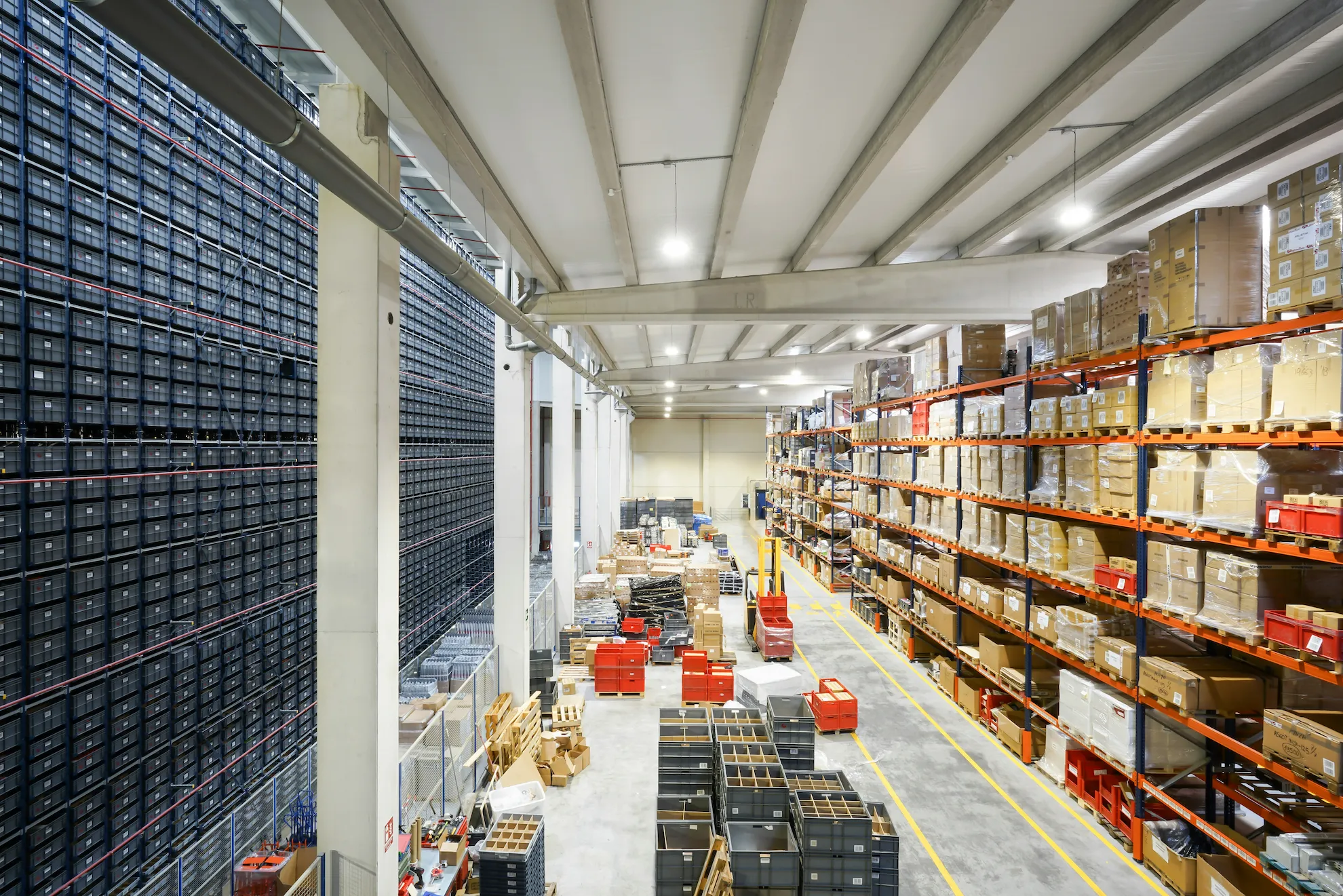
Cleaning warehouse and distribution center floors is different from cleaning almost anywhere else in a facility. These spaces are large, fast-moving, and constantly exposed to traffic, tire marks, dust, moisture, grease, dock grime, and seasonal debris. A product that works in a small back room may fall apart when it is pushed through a full auto-scrubber program across thousands of square feet.
If you are comparing floor cleaning chemicals for a warehouse, logistics hub, or large distribution operation, here is what to look for—and how to avoid ending up with a product that sounds good in a catalog but creates more labor on the floor.
A distribution center floor collects more than visible dirt. Daily traffic pushes rubber into concrete pores, forklifts leave behind tire marks, loading docks introduce grit and moisture, and leaks from equipment or batteries can create spots that require more aggressive chemistry. The result is a mixed-soil environment that demands a practical balance of cleaning strength, rinse performance, and floor safety.
That balance is especially important because warehouse cleaning is operational. You are not just trying to improve appearance. You are trying to maintain traction, protect workflow, support safety, and keep maintenance tasks from consuming too much labor.
In high-traffic lanes, repeated turning, braking, and pivoting can leave dark tire marks that standard cleaners barely touch. These areas often need a stronger degreasing approach than the rest of the floor, especially around dock entrances, intersections, and staging zones.
Even facilities with good housekeeping programs bring in dirt from pallets, shipping materials, outdoor traffic, and open dock activity. Over time, that residue can combine with moisture and oil to form a stubborn film rather than loose debris.
Hydraulic leaks, maintenance activity, and mobile equipment can leave oily spots or wider contamination trails. If those areas are not cleaned with the right chemistry, they can become both a visual problem and a traction problem.
In colder months, snowmelt, salt, and slush can migrate from truck bays and entrances into the warehouse. Even if the visible moisture is removed, the floor can still be left with a film that affects cleanliness and safety.
If your facility uses auto scrubbers, foam control matters. Excess foam disrupts recovery performance, slows down operators, and can leave tanks and squeegees working harder than they should. A warehouse floor cleaner should be compatible with large-area machine cleaning, not just manual use.
The right chemistry should remove soil without leaving behind a sticky or dulling film. Floors that look cleaner for one shift and worse by the next morning usually point to residue problems, weak dilution control, or chemistry that is not right for the soil load.
Large buildings magnify chemical waste. A product that is even slightly overused can become expensive very quickly. That is why concentrated programs paired with accurate dispensing are often a better long-term choice than ready-to-use products for distribution operations.
Your floor program also needs to fit the actual materials in the building: concrete, sealed concrete, coated floors, dock surfaces, or adjacent stainless and hard-surface touchpoints. In addition, the chemical has to fit how your team works—night crew, day porter program, full scrubber passes, spot treatment, or dock-area foaming.
A low-foam, scrubber-friendly cleaner with solid rinsability is usually the best foundation. You want a product that can clean broad square footage efficiently without forcing operators to stop for excessive foam, repeated passes, or residue cleanup.
Heavier degreasing chemistry may be required in targeted zones such as maintenance corners, battery stations, entrances, and forklift staging areas. In those spaces, a stronger product can be used intentionally rather than across the entire building.
Some warehouse environments support food distribution, packaging, break areas, or temperature-controlled zones. In those cases, the chemical program may need a mix of floor care, spot degreasing, disinfecting, and cold-environment cleaning rather than a one-product answer.
In a large facility, inconsistency is expensive. One operator may under-dilute and lose performance. Another may over-dilute and waste product. Over a month, that inconsistency shows up in chemical spend, floor appearance, machine performance, and rework time.
That is why IRC’s dispensing systems are strategically important to the warehouse conversation. The company’s Hi-Flow Dispenser is specifically positioned as ideal for filling auto scrubbers and dispensing at 14 gallons per minute. For larger operations, that kind of speed can help teams refill efficiently while still maintaining a controlled chemical program.
IRC also offers other dispensing options, including the Fusion Pro systems and HydroFoamer, which broaden how a site can handle routine dilution, foaming application, and multi-chemical workflows across different areas of the building.
Optima and Optima Prime
These are strong products to evaluate when your facility needs concentrated hard-surface cleaning power. IRC positions Optima around high alkaline cleaning, hard-water performance, and economical dilution, while Optima Prime adds aluminum-safe design for more surface-sensitive environments.
Stealth and Stealth Plus
These are the better fit when the issue is heavier industrial grease, difficult soils, or contamination that requires more aggressive emulsification. They are especially useful to evaluate for problem zones rather than broad daily maintenance if the whole floor does not need that level of chemistry.
Power 7
Power 7 is worth considering when the facility wants a heavy-duty degreaser that can work across multiple soil types while remaining free-rinsing and suitable for even finished floors.
Blast-Off
Blast-Off is positioned as a self-foaming cleaner for tough messes and is described by IRC as safe to use on food surfaces. That makes it relevant when a warehouse has washdown-style zones or needs foaming action in targeted areas.
Hi-Flow Dispenser and other dispensing systems
For scrubber-based floor care, the dispensing side of the program may be just as valuable as the chemistry itself. Faster, more consistent filling can improve operator efficiency and reduce waste.
Inferno and Inferno Plus
If your operation includes freezers, cold docks, or below-freezing areas, IRC’s Inferno line becomes important. IRC positions these products for sub-zero environments where standard cleaners are not practical, which helps distribution centers that overlap with cold storage operations.
The best warehouse floor cleaner is not simply the strongest product on the shelf. It is the chemical program that fits your soils, your machine setup, your traffic patterns, and your labor reality. In many distribution centers, the winning solution is a combination of low-foam daily cleaning, stronger targeted degreasing for problem areas, and a dispensing process that keeps every mix consistent.
If your operation is trying to improve floor appearance, reduce slip risk, cut rework, or get more out of your scrubber program, IRC’s Distribution Centers page and On-Site Demo process are natural next steps.
For most large facilities, the best starting point is a low-foam cleaner that performs well in an auto-scrubber program and rinses without leaving residue. Problem zones may still require a stronger degreaser.
Usually because the chemistry is too weak for the soil, the floor is being under-diluted or over-diluted, or the cleaning process is not targeting the highest-friction areas effectively.
Often, yes. Many facilities benefit from a daily maintenance cleaner for broad floor care and a stronger degreaser for maintenance areas, dock corners, and traffic intersections.
It keeps chemical use consistent from shift to shift, reduces overspend, and improves the odds that the product will perform the way it was designed to perform.
Then the floor-care program may need a cold-environment cleaner in addition to the main warehouse chemistry. IRC’s Inferno and Inferno Plus lines are designed for those below-freezing applications.