
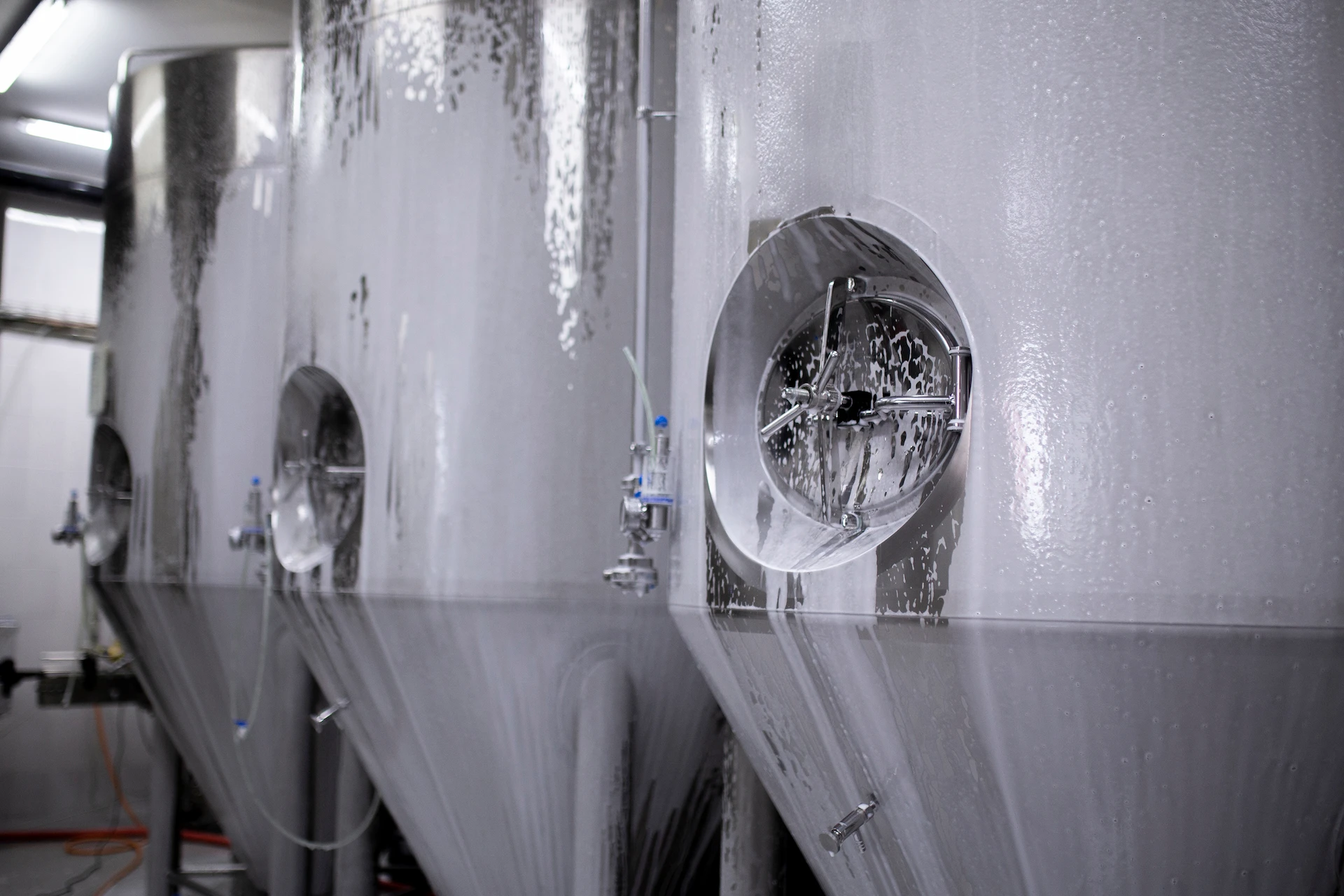
A foaming degreaser cleans better than a spray wherever the soil is not sitting on a flat floor: walls, equipment frames, conveyor legs, cooler panels and overhead structure. Foam carries the same chemistry a sprayer does, but it clings instead of running, so the product stays in contact with the grease long enough to break it down.
That is the whole argument for foam. What follows is where foam earns its rinse step, where it gets in the way, and how to run a foaming unit so the dilution on the wall matches the dilution on the label.
What foam actually changes
Foam wins when gravity is working against the chemistry. A liquid spray on a tiled wall starts running the second it lands, so the product that was supposed to dwell for five minutes is on the floor in ten seconds. Foam holds position, which is the only way a vertical surface gets the same contact time a floor gets for free.
Contact time is doing the work, not the pressure of the spray. Alkaline chemistry lifts grease by breaking fats and oils into pieces water can carry away, and that reaction needs time at the soil, so an application method that doubles dwell does more than switching to a stronger product. Our guide to pH in cleaning chemicals covers which end of the scale belongs on which soil.
The second gain is coverage you can see. White foam on a grey wall shows the gaps, which matters in plants where walls and overhead structure are part of the sanitation program. In USDA-inspected meat and poultry establishments, walls, floors and ceilings must be built of durable, moisture-impervious materials and cleaned and sanitized as necessary to prevent adulteration of product, and those are exactly the surfaces a trigger bottle covers slowest.
| Application | Where it fits | What you gain | What it costs |
|---|---|---|---|
| Foam | Walls, splash zones, equipment exteriors, overhead, washdown rooms | Long contact on vertical surfaces, visible coverage, fast area coverage | A rinse step, water use, a dedicated foaming unit |
| Trigger spray | Spot work, stainless wipe-downs, panels you cannot rinse | Control, little water, no hose | Short dwell, slow over large areas, uneven coverage |
| Flood and recover | Open floors, aisles, dock areas | Mechanical action plus recovery in one pass | No use on verticals, and foam fouls the recovery tank |
Finished floors cleaned with an auto scrubber are the clearest case. Foam in the recovery tank trips float switches, carries over into the vacuum motor and slows the whole fill and dump cycle, which is why scrubber programs run low-foam chemistry and a defoamer instead. Our auto scrubber chemical guide sets out that side of the program.
Foam is also wrong on anything you cannot rinse. Control panels, motor housings, electronics, open bearings and sensitive electrical gear want a damp cloth and a controlled spray, not a blanket of wet chemistry that runs into places you cannot see. Light daily wipe-downs do not need it either, because a neutral cleaner and a cloth finish faster than foam plus a rinse.
Treat foam as the heavy pass: scheduled washdown, deep cleans, and grease that has built up in a corner nobody reaches during production.
The method matters as much as the product. A foaming unit attaches to a hose and a container of concentrate, mixes the product with water and air, and lays it on the surface. IRC's HydroFoamer works that way: attach your product and hose, spray the foaming product, scrub, then use the hose to rinse.
Do not let the foam dry
Rinse the surface while the foam is still wet. Alkaline chemistry that dries on stainless, painted steel or aluminum leaves a film your crew has to clean twice, and on soft metals a drying high-pH solution has longer to attack the surface than anyone intended.
University of Florida IFAS guidance on equipment cleaning and sanitizing makes the point that intimate contact is as important as prolonged contact, and notes that cleaning chemicals are foamed onto surfaces in some applications. Foam buys you the time; the brush and the rinse finish the job.
A foaming unit delivers whatever ratio the dispenser is set to, which is why foam belongs in the same conversation as dilution control rather than in a separate one about equipment. Eductor dispensers depend on adequate flow and pressure, and low pressure changes the delivered ratio whatever the tip is rated for. A crew that gets weak foam usually has a water supply problem, not a chemistry problem.
Match the concentrate to the unit as well. Blast-Off is a concentrated self-foaming cleaner for meat packing plants, bakeries and other food plants, and it can be applied mechanically or manually, so the same product covers a foam pass and a bucket job. Where aluminum and soft metals are in the mix, Optima Prime is the controlled-alkaline option at pH 11.2 in 1% solution, aluminum-safe by design.
Set the ratio once, post it at the station, and stop mixing by feel. On IRC units, foaming applications run at HydroFoamer works with any of the IRC products, and the rest of the station logic is in our guide to dilution control systems.
A demo on your walls settles the argument faster than a data sheet. We bring the chemistry and the dispensing, run a pass in your plant, and show the dilution the unit actually delivers.
Food service kitchens are the first case: fryer walls, splash zones behind the line and equipment exteriors collect grease faster than the floor does, and a foam pass covers them in one go. Our food service degreaser guide matches chemistry to each of those surfaces, and the food service page shows where foam sits in that program.
Corrugated and flexographic plants use it on press frames, guards and the structure around the ink system, where overspray dries where nobody can reach it with a cloth. See corrugated printing plate and press cleaning for the chemistry that belongs near plates and rolls, which is not the same chemistry you foam on a wall.
In OEM assembly and stamping plants, the targets are press guards, racks, conveyor legs and the oily mist film on everything vertical near a stamping line. Same principle in all three: the floor has a machine, the walls have a crew, and foam is how the crew keeps up.
Yes, on the surfaces that need dwell time. Foam does not clean harder than the same product sprayed on, it simply stays put long enough for the chemistry to act, which is the difference between a clean wall and a streaked one.
The right one is the alkaline concentrate that matches your soil and your surface, applied through a unit that holds the ratio. In the IRC line, Blast-Off is the self-foaming concentrate written for food plant soils, and Optima Prime is the controlled-alkaline choice where aluminum and soft metals are involved.
You can, for heavy grease in a washdown area that drains, but not for daily scrubber work. Foam and recovery tanks do not get along, so keep floor programs on low-foam chemistry.
Rinse it, and rinse it before it dries. Any food-contact surface also needs its sanitizing step after the rinse, because cleaning and sanitizing are two separate jobs.
Follow the dwell time on the product's label for the soil you are cleaning, and watch the edges of the foam blanket while you wait. If it starts drying before the time is up, the area is too warm or too airy for that pass, so work in smaller sections.
Keep reading