
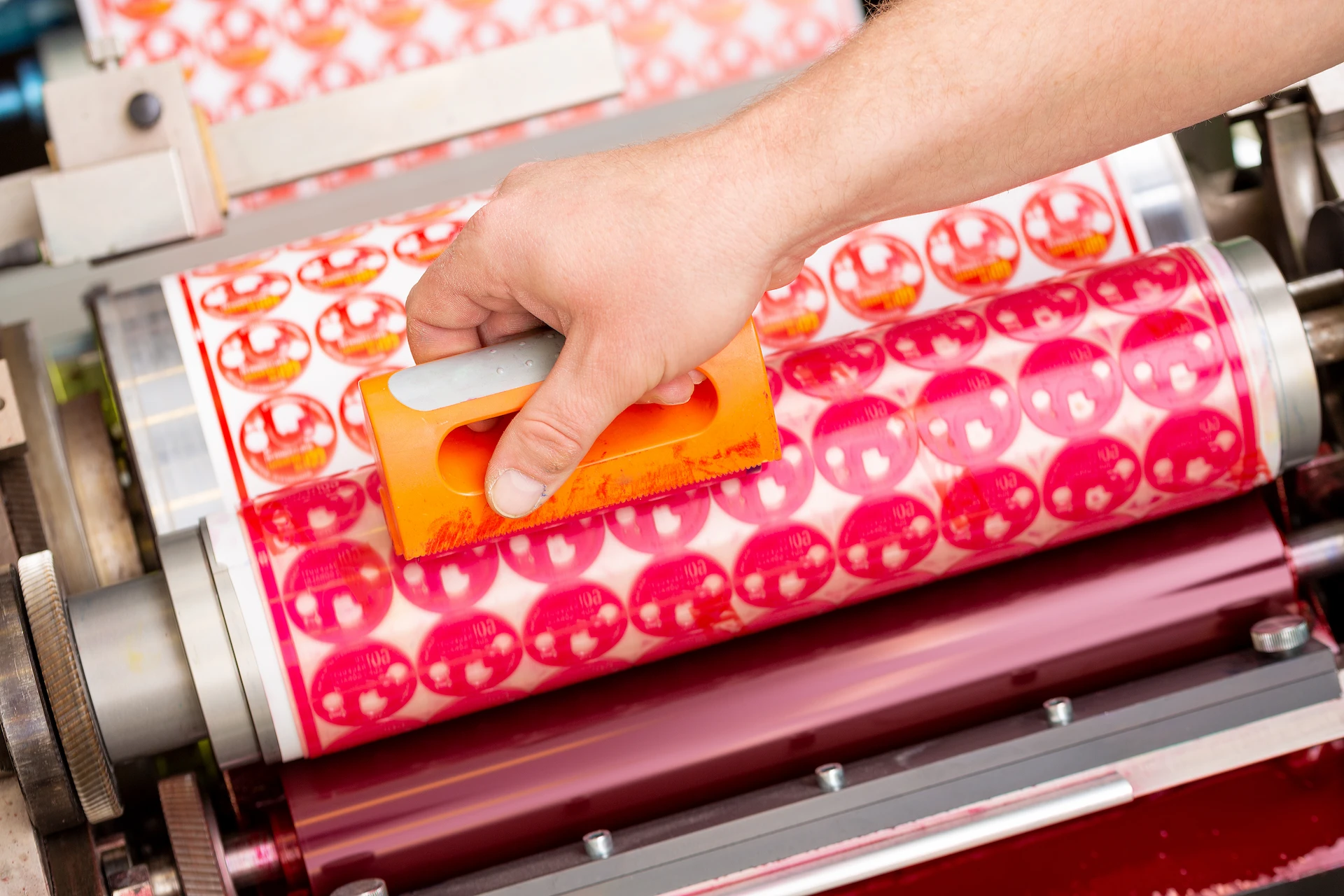
Anilox roll cleaning means getting dried ink, coating and debris out of the engraved cells without wearing down the engraving that meters your ink. Day to day, that means a print-specific cleaner mixed at a fixed dilution, enough dwell time, a brush matched to the engraving, and a full rinse after every job. When routine washing stops bringing back cell volume, the roll needs a deeper method: a chemical soak or automated washer, soda blasting, ultrasonic or laser cleaning, or a trip to a restoration specialist.
The roll is usually the most expensive part of the press, and the difference between one that meters correctly for years and one that gets re-engraved early is usually process, not product. This guide covers what builds up in the cells, how the cleaning methods compare, the wash-up sequence to standardize on, how often to clean, and where plants damage rolls. It is written for the people who run the wash-up, not for a lab.
IRC’s corrugated printing plate and press cleaning program is built around that balance between soil removal and equipment protection, and the products referenced throughout are the ones our corrugated customers use most.
An anilox roll does one job: deliver a metered, repeatable volume of ink to the plate. It does that through millions of engraved cells, each one holding a fixed volume. When those cells are partially filled with dried ink, coating, or fine debris, the roll delivers less ink than the engraving specifies, and it does so unevenly across the face.
Operators feel this before they diagnose it. Color drifts between runs that should match. Solids look weak. Dot gain moves. Crews compensate mechanically: more impression, more pressure, another wash-up. The press wears faster while the actual cause sits in the cells.
The relationship is not linear, either. A roll does not lose ten percent of its performance when ten percent of its cells plug. Fine-line-screen rolls with small, shallow cells lose usable volume faster than coarse rolls, because the same film of dried residue represents a much larger share of a small cell. That is why the highest-value rolls in a plant are usually the ones most at risk from a lax cleaning schedule.
Not every dirty roll is dirty for the same reason, and the cause determines the cleaner. Four things account for most of what a corrugated pressroom finds in its cells.
The most common cause, and the most preventable. Water-based flexo inks are designed to dry, and they do not distinguish between board and engraving. A roll left through a long changeover, a lunch break, or an unplanned downtime event can set ink hard enough that a routine wash-up no longer reaches the cell floor.
This is the slow version of the same problem. Each wash-up that removes most but not all of the ink leaves a thin layer behind. Layer on layer, over weeks, that becomes a glazed film that a normal wash cycle will not touch. It usually shows up as a gradual, plant-wide decline in print density that nobody can pin to a single event.
Corrugated generates dust. Fiber and starch pick up ink, pack into cells, and combine with dried pigment to form a deposit that behaves differently from ink alone. Plants running recycled liner tend to see more of it.
The one nobody expects. A cleaner that foams excessively, rinses poorly, or gets mixed at the wrong ratio can leave its own film in the cells, or redeposit the ink it just released. This is why rinsability and foam profile matter as much as cleaning strength in an anilox roll cleaner.
There are six ways plants clean anilox rolls. Most use two: chemistry and a brush on press for every job, plus one deeper method on a schedule or when volume drops.
| Method | How it works | Where it fits | What to watch |
|---|---|---|---|
| Chemical and brush, on press | Print-specific cleaner, dwell, brush, rinse | Every wash-up and changeover | Dilution, brush type, rinse |
| Soak or automated washer | Roll sits in, or is sprayed with, recirculating cleaning solution, then rinsed | Weekly deep cleans, glazed rolls | Chemistry the machine is rated for, rinse quality |
| Baking soda blasting | Fine sodium bicarbonate media is air-blasted at the turning roll | Deep cleaning dried or packed cells | Dust control, correct media and pressure |
| Ultrasonic | Roll is submerged in a solution tank and high-frequency sound loosens residue in the cells | Off-press deep cleaning | Roll condition before cleaning, time and frequency limits |
| Laser | A focused beam removes residue from the cells with no chemistry or media | Off-press deep cleaning | Capital cost, roll maker’s approval |
| Restoration service | Specialist deep clean, or re-engraving when the engraving is worn | Volume will not come back with routine cleaning | Lead time, spare roll inventory |
The takeaway: deep cleaning methods fix what routine wash-ups miss, but they do not replace the wash-up. A plant that cleans properly after every job needs the expensive methods far less often.
Every other method sits on top of this one. Automated washers take the labor out of a deep clean, but they still run on chemistry, and a machine charged with the wrong cleaner or the wrong ratio cleans badly every time. Ask the machine maker what chemistry it is rated for, and dispense it at a fixed ratio rather than topping up by eye.
Soda blasting sends fine, evenly sized baking soda particles at the roll with compressed air. Bicarbonate is softer than ceramic or chrome, so used correctly it breaks up dried ink in the cells without cutting the engraving, and what is left behind dissolves in water. It needs containment for the dust and purpose-made media and equipment. Scrubbing a roll with baking soda paste and a rag is not the same process.
The roll comes off the press and goes into a tank of cleaning solution. High-frequency sound makes tiny bubbles that collapse inside the cells and lift residue. It reaches deep into fine engravings, but it is not gentle on a roll that is already damaged: a 2023 study published in Coatings found that ultrasonic cleaning made existing damage worse, in some cases to full delamination. Inspect the roll before it goes in the tank.
A focused laser removes residue from the cells without chemicals, water or blast media. It is the newest option and the most expensive to buy, and it is usually done off press. Check with your roll maker before you laser-clean a roll it supplied.
If a deep clean does not bring cell volume back, or the roll shows scoring, chips or worn cell walls, the problem is no longer cleaning. That is where a restoration or anilox cleaning service earns its fee, and where crews should stop escalating chemistry and scrubbing on press.
The sequence below is the one to standardize on. Each step exists because skipping it is a documented way to lose a roll.
Two questions decide everything that follows: what is on the roll, and what is the roll (and everything around it) made of. Fresh water-based ink, a cured acrylic glaze, and fiber-packed cells do not respond to the same chemistry or the same dwell time. Ceramic and chrome engravings tolerate different handling, and the components adjacent to the roll, such as end journals, sleeves, bearer surfaces and aluminum housings, often set the real chemistry limit, not the roll face itself.
Write this down once, per press, as part of the standard. Crews should not be re-deciding it per shift.
General-purpose heavy-duty degreasers are the single most common cause of avoidable anilox damage, because they are formulated to attack soil without any consideration for engraved surfaces or soft metals. A print-specific cleaner is designed to penetrate and suspend pigment and acrylic so it rinses away instead of redepositing.
Prevail is IRC’s ink remover for this application: solvent-free, phosphate-free, water/soy-based, and formulated to penetrate, release, and suspend pigments and acrylics so ink does not redeposit in print cylinder cells. It is safe on photopolymer and rubber plates as well as flexographic and gravure print cylinders, carries an HMIS 0-0-0 rating, and works under hard water conditions.
Prevail’s product page rates it safe on all metals, including aluminum, and its label says to check before using it on the softest metals. Where you want a controlled-alkaline cleaner for the hardware around the roll, such as housings, certain sleeve constructions and nearby press parts, Optima Prime is aluminum-safe by design and built with corrosion inhibitors for ink-industry soils.
Hand-mixing is where a good cleaning standard goes to die. A crew that pours “a bit extra because it was really bad” is running chemistry stronger than the compatibility testing that approved it, and a crew that stretches the drum is running it too weak and compensating with longer dwell and harder scrubbing. Both damage rolls.
If your crews still mix by the ounce, our dilution ratio chart turns the ratio on the label into the ounces they actually pour. A wall-mounted dispenser removes the variable entirely. The Fusion Pro One Chemical Dispenser delivers one chemical at a set rate to both bucket and bottle outputs; the Fusion Pro Four Chemical Dispenser does the same for up to four products from one station. If you want the full case for this, we covered it in Dilution Control Systems: How They Reduce Chemical Waste and Cleaning Costs.
Apply evenly across the full face. Give the cleaner the contact time it needs to penetrate. That is what does the work, not pressure. Agitate with a brush approved for your engraving type; on ceramic that generally means a stainless or brass brush appropriate to the line screen, and on chrome it means something gentler. Steel wool, scouring pads, and improvised abrasives have no place near an engraved surface.
The rule that keeps rolls alive: increase dwell time before you increase mechanical force, and increase mechanical force before you increase concentration.
The rinse is the step most often shortened, and it is where suspended ink either leaves the roll or settles back into the cells. Flush the full face with clean water until the runoff is clear, and rinse the surrounding components as well. Residual alkaline chemistry sitting on an aluminum housing overnight is its own maintenance problem.
Wipe the roll dry rather than letting it air-dry with mineral-laden water on the surface. Then look at it. A quick inspection under good light, ideally with a loupe or a cell-volume reading if your plant has the equipment, tells you whether the cells are actually open or whether you have just cleaned the top of a glaze. Log what you find. A roll that needs a longer dwell every month is a roll that is losing ground.
For general cleanup of press guards, frames, and floor areas after a wash-up, a neutral cleaner such as Lavender Legend handles the surrounding surfaces without introducing another alkaline product into the roll’s environment.
Frequency is the variable with the largest effect on roll life, and it is almost always the one plants get wrong. The table below is a workable default for a corrugated operation running water-based inks. Adjust it to your ink system, run lengths, and ambient conditions, but adjust it as a documented standard, not per shift.
| Cleaning level | When | Method | What it prevents |
|---|---|---|---|
| Wash-up | End of every job or colour change | Print-specific cleaner at standard dilution, full-face application, dwell, brush, rinse, dry | Fresh ink drying in the cells: the single largest cause of cell plugging |
| Extended downtime | Any unplanned stop over roughly 20-30 minutes with ink on the roll | Same as wash-up, run immediately rather than at the end of the stop | A short mechanical delay turning into a cured-ink problem |
| Deep clean | Weekly, or at a set run-hour interval | Longer dwell, full brush agitation across the face, thorough rinse and inspection | The cumulative glaze that routine wash-ups leave behind |
| Inspection and volume check | Monthly | Visual inspection under magnification; cell volume reading where equipment allows; log the result | Gradual density loss going unnoticed until print quality complaints start |
| Restoration | Only when routine cleaning no longer restores volume | Off-press deep clean or specialist restoration, per the roll manufacturer’s guidance | Crews escalating to aggressive chemistry or abrasives on-press to solve a problem that needs a different process |
The pattern to notice: four of those five rows are low-effort and frequent. Roll damage is overwhelmingly a consequence of infrequent cleaning escalating into aggressive cleaning, not of cleaning too often.
Very little anilox damage is caused by a single dramatic mistake. It accumulates through a handful of ordinary habits.
The primary anilox roll cleaner in the IRC line for water-based flexo work. Solvent-free and water/soy-based, formulated to work like a petroleum solvent without the employee and environmental exposure, and specifically built to prevent ink redeposition in print cylinder cells. Super-concentrated, so the finished-use cost stays low when it is dispensed at a controlled ratio.
A controlled-alkaline cleaner (pH 11.2 in 1% solution) that is safe for soft metals and aluminum-safe by design, with corrosion inhibitors and surfactants aimed at ink-industry soils. Medium-to-low foaming and free rinsing. This is the option when the compatibility constraint is the hardware around the roll rather than the roll itself.
A pH-neutral, non-dulling, super-concentrated multi-purpose cleaner for guards, frames, work surfaces, and floors near the press: the surfaces that get overspray but do not need alkaline chemistry.
Fusion Pro dispensers fix the ratio at the wall so bucket, bottle, and machine fills come out the same every time. For plants standardizing several products across a pressroom, the four-chemical station consolidates the whole mixing process into one documented point.
Browse the full range on the flexographic and corrugated printing category, or see how the product families differ in Cleaner vs. Degreaser vs. Disinfectant: What’s the Difference in Industrial Facilities?
A cleaning procedure that lives in someone’s head is not a program. The plants with the longest roll life tend to have four things written down and posted at the press: which cleaner goes with which soil, the exact dilution and where it is dispensed, the dwell time and approved brush for each engraving type, and the frequency table above with someone’s name against each row.
Add a simple log (date, roll, cleaning level, anything unusual) and within a quarter you will be able to see which rolls are drifting and which shift’s wash-ups are not landing. That is a far cheaper diagnostic than a re-engraving quote.
If you are working through chemistry selection more broadly, How to Choose the Right Industrial Degreaser for Your Facility covers the decision framework behind these choices.
Clean at the end of every job or color change, and immediately on any unplanned stop long enough for ink to begin drying. Add a weekly deep clean with longer dwell and full-face agitation, plus a monthly inspection. Frequent light cleaning is both safer and cheaper than periodic aggressive restoration.
Waiting. Once ink cures in the cells, crews escalate: stronger chemistry, longer dwell, harder scrubbing. That escalation is what damages engravings. Almost every aggressive cleaning event traces back to a wash-up that did not happen on time.
It is not advisable. General-purpose caustic degreasers are formulated for soil removal without regard for engraved surfaces, soft metals, seals, or plate materials. Use a cleaner formulated for print equipment, and where aluminum or soft metals are in contact, use a product that is specifically aluminum-safe.
Yes, indirectly but significantly. Hand-mixing means the actual concentration reaching the roll varies by operator and shift. That variance produces inconsistent cleaning, which produces compensating behaviour (more concentrate, more scrubbing), which is where damage originates. A fixed-ratio dispenser keeps the process inside the limits it was approved at.
It is the engraved roll in a flexo press that carries a set volume of ink to the plate. Its surface is covered in tiny cells, usually laser-engraved into ceramic or made in chrome, and the cell volume decides how much ink reaches the board.
The doctor blade. It wipes excess ink off the surface so only the ink in the cells moves to the plate. A worn or badly set blade scores the roll, and no amount of cleaning fixes a scored roll.
Yes, by soda blasting with purpose-made media and equipment. It is a deep-cleaning method, not a daily one, and it does not mean rubbing the roll with baking soda paste.
Clean in-house after every job and on your weekly deep-clean schedule. Use a service when in-house cleaning no longer brings back volume, or when the roll needs inspection or re-engraving.
Clean sooner, use chemistry built for print equipment, dilute it at a fixed ratio, rinse it completely, and inspect what you have done. Anilox rolls are not fragile. They are unforgiving of neglect followed by panic. A modest, boring, well-documented cleaning routine protects print quality, uptime, and the single most expensive consumable surface on the press.
IRC can review your current wash-up procedure, chemistry, and dilution setup against the rolls and inks you are actually running. Schedule an on-site demo and we will walk the pressroom with your team.