
If your janitorial closet looks anything like the ones we walk into every week, it’s a graveyard of half-empty bottles. A glass cleaner here. A degreaser there. A separate disinfectant. A bathroom-specific product. A carpet spotter. A floor cleaner. A neutral pH cleaner that was supposed to do everything but somehow ended up doing nothing especially well.
Every one of those bottles costs money. Every one takes up space. Every one needs its own training, its own safety data sheet, its own PPE conversation. And every one is a chance for the wrong product to end up on the wrong surface — or in the wrong hands.
The cleaning industry has been promising “one product does it all” for decades. The problem is that, until now, those promises came with compromises. A cleaner that also disinfects, but doesn’t really clean. A disinfectant that leaves so much residue your floors look worse than before you started. A “concentrate” that still requires three different SKUs to cover a building.
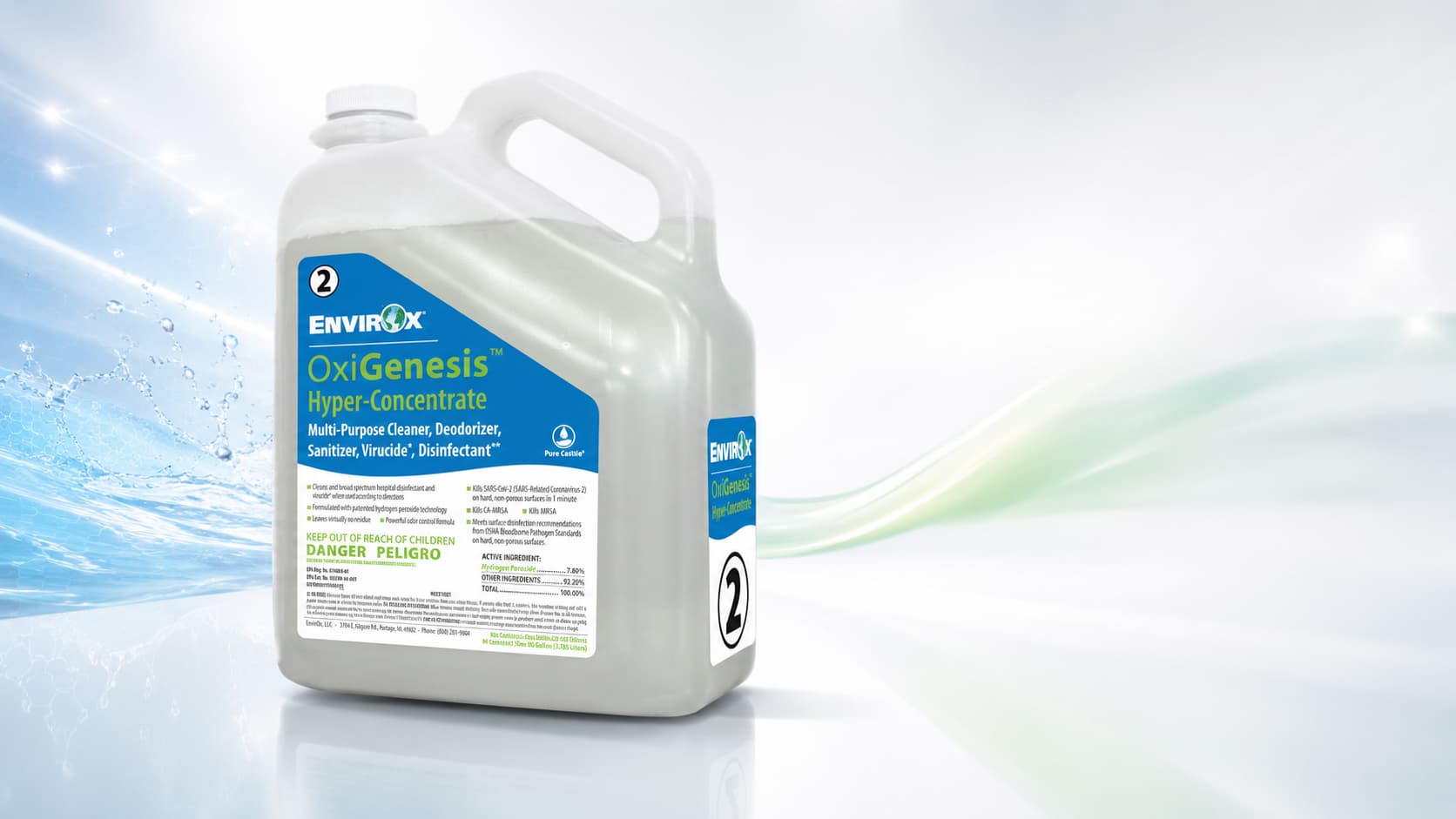
That ends today. IRC is proud to announce we’re now carrying EnvirOx OxiGenesis™ Hyper-Concentrate — and after putting it through its paces, we believe it’s the most important launch in commercial cleaning chemistry in years.
Most concentrates dilute somewhere between 1:32 and 1:128. OxiGenesis goes further. A single gallon of OxiGenesis Hyper-Concentrate produces:
That’s not a typo. One gallon. Up to 1,024 gallons of usable product. The math on cost-per-ready-to-use-gallon is where this product stops being interesting and starts being transformative for facility budgets.
A quick tip from our team: don’t compare case prices. Compare in-use cost. Divide the cost of a gallon of OxiGenesis by the yield at the dilution you’ll actually use, and the picture changes completely. We’re happy to run that side-by-side comparison against whatever you’re using today — just ask.
OxiGenesis ships into the Absolute™ Cleaning System — EnvirOx’s closed-loop, color-coded dispensing platform. Train your team once on a single product, and the dispenser does the rest. The wall-mounted YGBR unit handles all four dilutions; a portable dispenser handles Green and Red for in-room work.
Here’s what each color does:
Yellow (1:512) — Floor Care. Daily mopping and auto-scrubber work. Low foam, no rinse, no sticky residue. Available through the YGBR dispenser.
Green (1:256) — Everyday Cleaning. Streak-free glass and mirrors. Stainless steel. Carpet bonnet cleaning. General wipe-downs. The workhorse dilution most of your team will reach for most of the time.
Blue (1:51.2) — Sanitizer & Heavy Cleaning. NSF D1-certified sanitizer for food-contact surfaces (when used as directed). Wipe-down cleaning for heavier soils. Carpet spot remover. Pre-spray for extraction. Odor elimination on urine and garbage. Sanitizes against six bacteria including Staph aureus, E. coli, Salmonella, and Pseudomonas.
Red (1:25.6) — Broad-Spectrum Hospital Disinfectant. This is where OxiGenesis really separates from the pack. Bathrooms, showers, tile and grout, and any major touchpoint where disinfection is required. Heavy degreasing. Mold and mildew. Heavy carpet spotting. And the full disinfection claim list — which we’ll get to in a minute.
One product. Four buttons on a dispenser. Ninety-nine percent of what a facility actually needs to do.
OxiGenesis Hyper-Concentrate is built on 7.80% hydrogen peroxide — stabilized and balanced using EnvirOx’s patented formulation technology. This is the same H₂O₂ chemistry the company has been refining since the original H2Orange2® launched in 1995, and it’s the foundation of why this product behaves differently from the quaternary ammonium (“quat”) disinfectants that dominate the market.
What does that mean in practice?
Low residue. Quats leave a film. That film gets sticky. It traps soil. It can turn into a biofilm — a microbial breeding ground that actually undermines the disinfection it was supposed to provide. EnvirOx has shown floor-by-floor before-and-after results where switching to H₂O₂ chemistry actually pulled up legacy quat residue, revealing surfaces underneath that hadn’t looked clean in years.
No harsh fumes. No alcohol smell. No bleach-style off-gassing. Custodians can work in occupied spaces without driving people out of the room.
Broad surface compatibility. Non-corrosive, non-abrasive, and safe on the vast majority of non-porous, water-safe surfaces. (As always, test an inconspicuous area first on anything sensitive.)
No PPE required when diluted and used as directed. Read that again. A hospital-grade broad-spectrum disinfectant that doesn’t require gloves, goggles, or a respirator at the point of use. For facilities with high custodial turnover — which is most facilities right now — that single fact reshapes training, compliance, and worker comfort.
OxiGenesis Hyper-Concentrate is registered with the EPA (Reg. No. 69268-6) and meets surface disinfection recommendations from the OSHA Bloodborne Pathogen Standards on hard, non-porous surfaces. Here’s the disinfection profile at a glance:
19 bacteria killed at the Red disinfectant dilution in five minutes or less — including nine multi-drug-resistant organisms (MDROs):
10 enveloped viruses in one minute (30 seconds for HIV-1):
5 non-enveloped viruses — historically the hardest category to kill:
For schools, healthcare adjacent facilities, food service, fitness centers, and any high-traffic public-facing environment, that norovirus claim alone is worth the conversation.
Some products on the market advertise themselves as “one-step” cleaner-disinfectants. The pitch is appealing: spray, walk away, done. The reality, per CDC guidance and decades of microbiology, is less convenient.
Disinfection is a process. You clean first. Then you disinfect. The reason is simple: if dirt, grease, or organic soil is on a surface, your disinfectant has to fight through that layer before it can ever reach the pathogen underneath. Worse, soil and existing chemical residue can give microbes a place to hide. You end up with a surface that’s neither properly clean nor properly disinfected.
OxiGenesis Hyper-Concentrate is a true cleaner and a true disinfectant — but it still asks you to follow the process. Clean the surface with the Green or Blue dilution. Then disinfect where disinfection is needed with the Red dilution. Same chemistry. Same dispenser. Same product on the wall. The difference is in the dwell time and the dilution.
This is also why OxiGenesis isn’t trying to replace 100% of products in a facility. The honest claim is 99%. There will always be specialty applications — heavy-duty stripping, certain food-contact protocols, niche industrial uses — that need a specialty product. But for the everyday cleaning and disinfection that consumes most of your custodial labor and most of your chemical budget, this one bottle covers it.
If you’re a facility manager or operations lead, here’s the part that matters to your CFO:
Fewer SKUs. One product replaces a glass cleaner, a neutral floor cleaner, a restroom cleaner, a carpet spotter, a tile and grout cleaner, a general degreaser, an odor eliminator, a sanitizer, and a broad-spectrum disinfectant. That’s nine product lines collapsed into one.
Less inventory. Less storage. Less cardboard waste. Less to track, less to reorder, less to lose track of.
Faster training. EnvirOx’s Train in Ten™ program is built around the single-product reality. New hires get up to speed dramatically faster — and given the cleaning industry’s well-documented labor turnover challenges (the 2025 Kline Report flagged simplified routines as a top end-user demand precisely because of this), training velocity translates directly to operational stability.
Lower labor cost per task. No-rinse formula. No need to switch products between tasks. No PPE donning and doffing between rooms when diluted properly.
Less surface damage. Quat-residue floors don’t just look bad — they get repaired and replaced sooner. Non-corrosive, low-residue chemistry extends the life of the surfaces it’s used on.
Lower workers’ comp exposure. No harsh fumes, no PPE-required handling in use, and reduced slip-and-fall risk from sticky or slippery residue.
The case price of a hyper-concentrate is going to look higher than a ready-to-use product on the shelf. That’s the wrong comparison. The right comparison is cost-per-ready-to-use-gallon, multiplied by the number of products you’re consolidating, plus the soft savings on labor, training, surface lifecycle, and waste. Run that math and OxiGenesis isn’t expensive. It’s the cheapest thing on your floor.
We’ve been in the commercial cleaning supply business long enough to be skeptical of “revolutionary” launches. Most of the time, “new” means “repackaged.” This one is different.
OxiGenesis Hyper-Concentrate is the product EnvirOx’s chemists openly say they’ve been trying to build for thirty years — a stable concentrate that survives real-world water variability, delivers true hospital-grade disinfection, cleans on par with their flagship multi-purpose formula, and does it all without the PPE burden of a traditional disinfectant. That’s not marketing copy. That’s a hard chemistry problem they finally solved.
For our customers across commercial real estate, distribution centers, automotive operations, education, and beyond, this is the kind of consolidation tool that genuinely changes how a building runs. Less complexity. Lower cost-in-use. Better outcomes for the people doing the work and the people walking the halls.
We’d love to run a cost-in-use comparison against your current cleaning and disinfection program. Bring us your current chemical list and we’ll show you, line by line, what OxiGenesis Hyper-Concentrate would replace, what it would cost, and what you’d save.
Contact your IRC representative today, or schedule a walkthrough and demo of the Absolute™ Cleaning System.
One product. Four dilutions. Ninety-nine percent of your facility’s cleaning and disinfection needs. The math has finally caught up to the promise.
EnvirOx OxiGenesis™ Hyper-Concentrate is EPA Registered (Reg. No. 69268-6) and NSF D1 certified. PPE is not required when the product is diluted and used as directed; always consult the product SDS for complete handling information. Contact times and approved use-sites vary by organism — see product label and IRC technical literature for full specifications.