
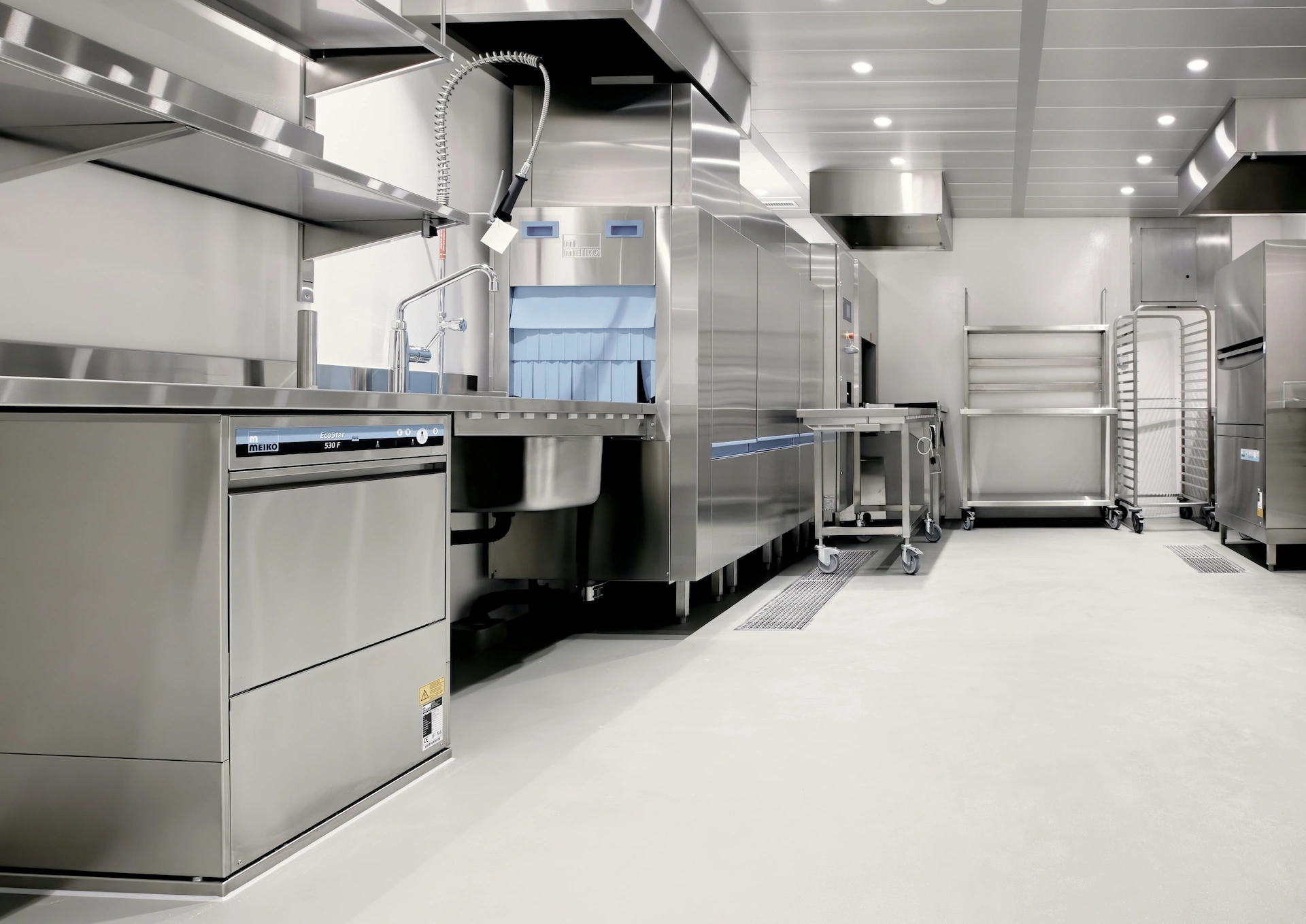
Stainless steel is the default surface in food service and food distribution, and it is the surface people complain about most. It shows every fingerprint, it streaks if you look at it wrong, and it collects three or four completely different soils within twenty feet of each other. A prep table carries light food film. A panel behind a fryer carries baked-on grease aerosol. A walk-in door handle carries hand oil. A rack in a distribution cooler carries dust and condensation spotting.
Which is why choosing a stainless steel cleaner for food service is not really a product question. One product cannot be both aggressive enough for grease aerosol and gentle enough to leave a streak-free finish on a customer-facing panel — those are opposite jobs. The facilities that stop fighting stainless are the ones that sort their surfaces into two or three jobs, assign one product to each, and stop asking any of them to do the others.
This guide sorts the jobs, names what IRC would put on each, and spends real time on the part most guides skip: why stainless streaks, films and spots in the first place, and which of those causes is the cleaner’s fault.
Stainless is not stain-proof and it is not inert. It resists corrosion because chromium in the alloy forms a thin passive oxide layer at the surface. That layer is what you are protecting when you choose a cleaner, and it is why two categories of product cause the damage people blame on “harsh chemicals”: chlorides, and abrasives.
Chlorides — from bleach-based products, some sanitizers, salt, and hard-water residue left to dry — attack the passive layer locally and produce pitting and rust-coloured spotting on a surface that is supposedly rustproof. Abrasives, including scouring pads and gritty powders, scratch across the grain and create a rougher surface that then holds soil faster than it did before. Neither shows up on day one. Both are cumulative, which is why the stainless in a facility that has been over-treating for two years looks worse than the stainless in a facility that cleans less often but cleans correctly.
The practical consequence: on stainless, the goal is to remove soil with chemistry and dwell time rather than with force, then rinse and dry so nothing is left behind to dry down. Almost every stainless complaint traces back to something being left on the surface — soil, product, or water.
Walk the facility and put every stainless surface into one of these. Do it once, mark it on a map, and the product decision makes itself afterwards.
| Job | What it looks like | Where it is | What it needs |
| Daily wipe-down | Fingerprints, light food film, dust, splash marks, water spots | Prep tables, equipment exteriors, doors, wall panels, cooler racks, handles | A neutral multi-surface cleaner, free-rinsing and non-dulling, at a light dilution |
| Grease removal | Tacky or hazy film, cooked-on residue, aerosol grease that has drifted onto a vertical surface | Cook-line surrounds, hood and fryer surrounds, ventilation panels, back-of-house walls | A heavy-duty degreaser with dwell time, followed by a rinse |
| Periodic deep clean | Built-up soil in a scheduled task, vertical surfaces that need the product to stay put | Food plant and commissary walls, tanks, large equipment exteriors, ceilings | A foaming cleaner that clings long enough to work, applied mechanically or manually |
Most facilities discover they have been running one product across all three rows: usually the degreaser, because it is the one that visibly “works”. That is exactly the pattern that produces dull, hazy, streaky stainless in the customer-facing areas, because a strong alkaline product used without a rinse on a light-soil surface leaves more behind than it took off. If the alkaline-versus-neutral distinction is new to your team, it is worth ten minutes on pH in cleaning chemicals before you shortlist anything.
Caliber is IRC’s multi-purpose, multi-surface neutral cleaner, and for routine stainless it is the default. Neutral pH means it is not fighting the passive layer; IRC describes it as free-rinsing and non-dulling even on finished floors, safe to use on all surface substrates, and effective under hard water conditions — which matters more than it sounds, because hard water is the usual reason a “clean” stainless panel dries with a white haze. It runs through spray bottles, buckets, auto scrubbers, and foaming or brush methods, so one concentrate covers the daily route. IRC’s own note on Caliber is to check before use on the softest metals, so treat aluminium trim and soft-metal fittings as a spot-test, not an assumption.
Power 7 is the heavy-duty degreaser IRC positions for exactly this mix: many soil types, “including kitchen surfaces and industrial cleanups”. The two claims that make it a stainless product rather than just a strong one are that it is free-rinsing and non-dulling even on finished floors, and safe to use on all surface substrates. It is highly dilutable, so the same drum covers a strong mix for the fryer surround and a weaker mix for the wall six feet away. Use it where a neutral cleaner is being asked to do three passes — and rinse it, because the whole point of a free-rinsing product is wasted if nobody rinses.
Blast-Off is a concentrated self-foaming cleaner IRC specifies for meat packing plants, bakeries and other food plants, applied mechanically or manually, and described as safe to use on food surfaces. Foam is the reason to reach for it: on a vertical stainless wall or a tank exterior, a liquid runs to the floor in seconds and a foam stays in contact long enough to do chemistry. This is a master-sanitation-schedule product rather than a daily one. It carries NSF certification on its product page.
Ultra Glass is a super-concentrated glass and mirror cleaner with a non-dulling formula, and IRC describes it as powering through greasy smudges, dried-on dirt and water spots to a streak-free finish. IRC’s copy is written around glass, and the product sits in the Glass & Stainless-Steel Cleaners category alongside Caliber. Use it the way its name suggests: the final appearance pass on high-visibility surfaces — display glass, sneeze guards, and the polished stainless next to them — after the soil is already gone. It is not the product that removes the grease; it is the one that makes the area look finished.
If a surface is worse than any of the four can handle — production-adjacent stainless with genuinely heavy industrial buildup — the escalation is Stealth, IRC’s most aggressive degreaser at pH 13.0 in a 1% solution. Treat that as a scheduled intervention on non-food-contact surfaces with a full rinse, not something that belongs on a daily cart. And for any surface that food touches, confirm the product’s food-contact status and its label directions with IRC before you put it in the rotation, because that is a label question rather than a preference.
The single most common process error in food environments is treating cleaning and sanitizing as one action performed with one product. They are different jobs with different mechanisms, and the order is not negotiable: clean first, rinse if the label says to, then sanitize where the area requires it, following your sanitation program and the product’s registered label.
The reason is soil load. Organic soil — grease, protein, food film — physically shields a surface and consumes sanitizer before it reaches anything. A sanitizer applied to a greasy panel is largely spent on the grease. That is why a facility that sanitizes diligently on top of an inadequate clean can still fail a swab, and why “we sanitize twice a day” is not an answer to a residue problem. The category-level version of this argument, including where each product type actually belongs, is set out in cleaner vs. degreaser vs. disinfectant.
For stainless specifically, add one more step that most SOPs omit: dry it. Water left to evaporate on stainless deposits whatever was dissolved in it, which is how you get spotting on a surface that was genuinely clean thirty seconds earlier.
Almost every stainless appearance complaint is one of five causes, and only two of them are the cleaner’s fault. Work down the list before you change products.
| What you see | Most likely cause | Fix |
| White film or spots that reappear after drying | Hard water minerals drying on the surface — not product residue | Dry the surface after the final wipe. Use chemistry formulated for hardness. Check your water hardness before blaming the cleaner. |
| Smeary streaks in the direction of wiping | Too much product, too little rinse, or a saturated cloth redistributing soil | Cut the dilution, use two cloths (one to clean, one to dry), and finish with the grain. |
| Dull, flat patches on a previously bright finish | Abrasive pads, or an aggressive product left on a light-soil surface without rinsing | Move that zone to a neutral cleaner. Retire the scouring pads. Damage from abrasion does not reverse. |
| Rust-coloured pinpoint spotting | Chloride attack on the passive layer — bleach-based products, salt, or sanitizer left to dry | Identify the chloride source and remove it from the process. Rinse and dry after any chlorinated product. |
| Tacky feel after cleaning | Grease emulsified but never rinsed away — the soil is still on the surface, just redistributed | Add the rinse step. This is the failure mode of using a degreaser like a spray-and-wipe. |
Two of those five point back at the water rather than the chemistry. If a facility has recurring white film across every stainless and glass surface at once, that is a hardness signature, and no change of cleaner will resolve it on its own.
A stainless program that depends on one experienced person mixing by eye lasts exactly as long as that person’s shift. Three things make it stick:
Kitchens with floors and walls in the same conversation should read this alongside the food service degreaser guide, which covers the surfaces this post deliberately leaves out. The full range for the food side sits under food service.
There is no single answer, because stainless in a food facility carries at least three different soils. A neutral multi-surface cleaner handles daily fingerprints and food film; a heavy-duty degreaser handles grease aerosol near the cook line; a foaming cleaner handles scheduled deep cleaning on vertical surfaces. Most facilities need two of the three, and the common mistake is using the degreaser everywhere, which dulls and streaks the surfaces that only needed the neutral cleaner.
In order of likelihood: hard water minerals drying on the surface, too much product with no rinse, a saturated cloth redistributing soil, abrasive pads scratching the finish, or an aggressive alkaline product used on a light-soil surface. Only the last two are permanent. Try drying the surface with a second clean cloth and cutting the dilution before you change products.
Daily wipe-down surfaces need it every shift or every day, because light soil removed early never becomes heavy soil. Grease-exposed surfaces near cooking equipment need a degreasing pass on a defined frequency rather than when someone notices. Deep-clean tasks belong on a written schedule with a named product and ratio, which is the part that survives turnover.
Sort your stainless into daily, greasy and scheduled. Put a neutral cleaner on the first, a rinsable degreaser on the second, and a foaming cleaner on the third. Clean before you sanitize, rinse when the label says to, and dry the surface — because most of what people call a cleaner problem is water and residue left to evaporate. Then fix the dilution so the program does not depend on who is working.
If your stainless looks worse than your cleaning schedule suggests it should, that is a diagnosable problem. Schedule an on-site demo and we will walk the zones with you.