
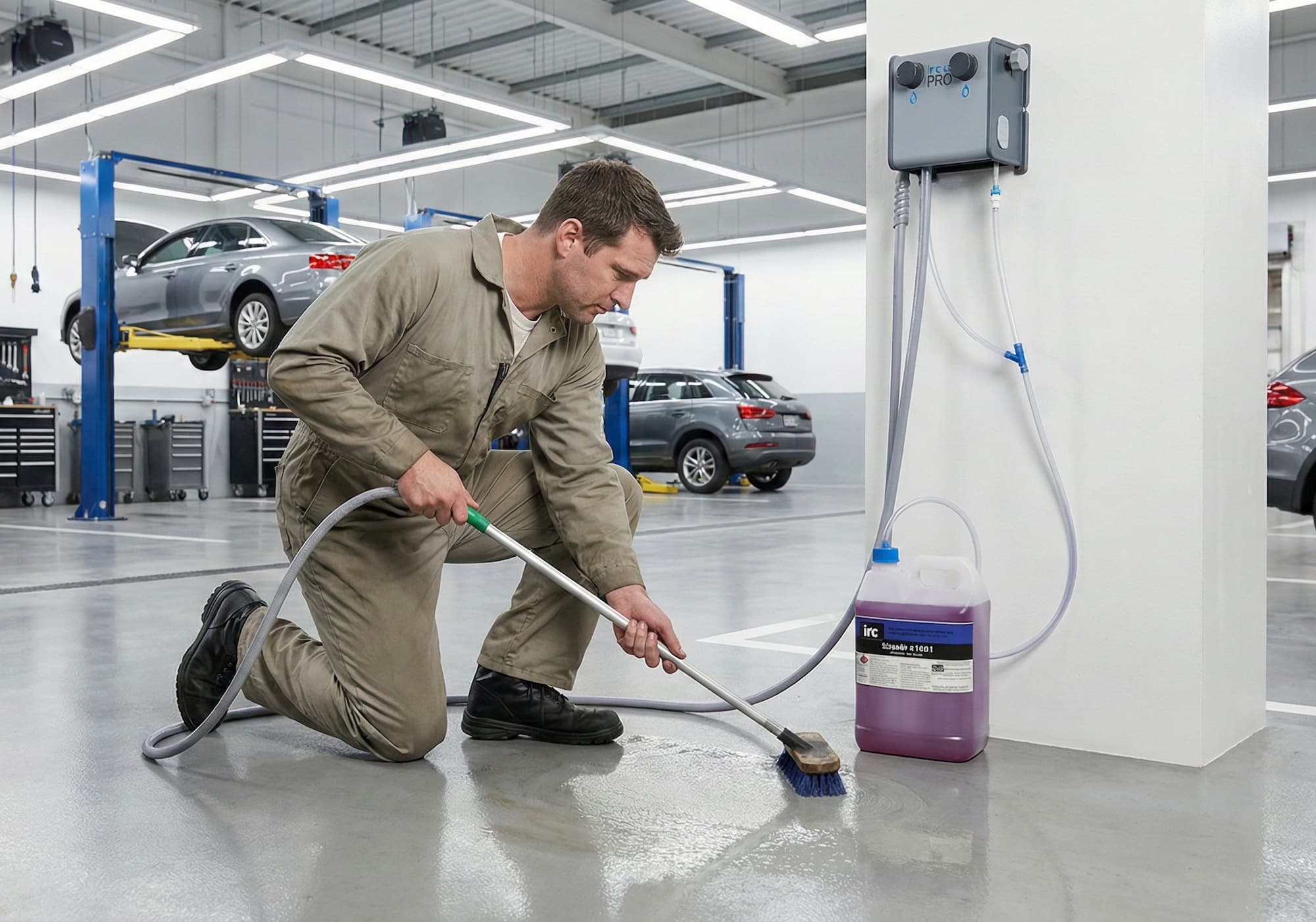
A chemical dilution control system does not just make mixing easier. In most facilities, it changes the economics of the entire cleaning program by reducing overuse, tightening process consistency, and making concentrated chemistry perform the way it was designed to perform.
IRC’s dilution-control lineup includes tools such as the Fusion Pro – One Chemical Dispenser, Fusion Pro – Four Chemical Dispenser, Hi-Flow Dispenser and HydroFoamer—each aimed at helping teams mix and apply chemistry more accurately for the task at hand.
This guide explains how dilution control systems reduce chemical waste and labor cost, how they support better cleaning performance, and when it makes sense to involve IRC for an On-Site Demo built around your current process.
Concentrated chemistry only delivers full value when the dilution is correct. In many facilities, that is exactly where money starts leaking out. Teams may overpour because they want stronger results, under-dilute because they are trying to stretch inventory, or mix by feel because the process has never been standardized. Each of those habits creates cost, and most of it stays invisible until someone looks closely at reorders, cleaning quality, and labor time.
A chemical dilution control system solves that problem by replacing guesswork with repeatable ratios. That change improves more than inventory usage. It affects first-pass cleaning performance, employee training, process safety, and how many SKUs a facility can manage without confusion.
When a concentrate is mixed incorrectly, the downside is not limited to product waste. Over-concentrated solutions can leave residue, create unnecessary foam, raise handling concerns, or make surfaces harder to recover cleanly. Under-concentrated solutions may fail to remove soil effectively, causing crews to repeat work or assume the chemistry itself is the problem.
Both errors cost money. The first one wastes chemistry. The second one wastes labor. In many facilities, both are happening at the same time in different departments or shifts.
A dilution control system meters concentrate and water into a repeatable finished-use solution. In practice, that means the system helps make the right product at the right strength for the right application, whether the team is filling bottles, mop buckets, autoscrubbers, or foam equipment.
That sounds simple, but it has a direct operational impact. When the ratio is stable, product performance becomes easier to evaluate. If a floor is still not getting clean, the manager can troubleshoot soil load, dwell time, mechanical action, or surface conditions instead of first asking whether the chemistry was mixed correctly.
The clearest savings come from eliminating overpouring. Many concentrated products are designed to work at specific use dilutions. If a crew adds more concentrate than necessary, the facility is paying premium pricing for no added cleaning benefit. In some cases, it may even get worse results due to residue or rinse difficulty.
IRC’s chemistry is built around super-concentrated formulas, lower waste, and lower operating cost. A dilution-control setup is one of the main ways those benefits become real in day-to-day use rather than staying on the label.
The case for dilution control is easiest to see in the arithmetic. The figures below use IRC list pricing for Caliber in a 55-gallon drum, at a facility using 25,000 finished gallons of cleaning solution a year.
| Scenario | Caliber concentrate at 1:64 | Caliber concentrate mixed at 1:32 (overpour) |
| Cost per gallon as purchased | $7.18 | $7.18 |
| Finished gallons per gallon purchased | 65 | 33 |
| Cost per finished gallon | $0.11 | $0.22 |
| Concentrate needed for 25,000 finished gal/yr | 385 gal | 758 gal |
| Annual chemical spend | $2,762 | $5,441 |
Same product, same purchase price, same cleaning result. A crew mixing at 1:32 because it works better stronger costs this facility about $2,679 a year in concentrate that does no additional work. Dilution control is what closes that gap, and it is why the payback period on a dispenser is usually measured in months.
Basis: Caliber 55-gallon drum at $395 list, or $7.18 per gallon (irccrc.com list pricing, July 2026). 25,000 finished gal/yr = 500 gal/week x 50 weeks. A 1:64 ratio means one part concentrate to 64 parts water, so 65 finished gallons per gallon of concentrate.
Facilities often notice the labor savings before they calculate the chemical savings. When a dispenser is installed, employees no longer have to estimate ratios, re-mix failed solutions, or stop to ask supervisors how strong a bottle or bucket should be. The result is a faster setup and a more consistent start to every cleaning task.
Labor savings also show up later in the workflow. Better dilution usually means fewer re-cleans, fewer complaints about inconsistent performance, and easier handoffs between departments or shifts.
Under OSHA’s Hazard Communication Standard, a container of diluted chemical that leaves the immediate control of the person who filled it has to be labeled with the product identity and appropriate hazard information. That covers most spray bottles and mop buckets in a facility. A permanent dilution station makes this practical: the products dispensed there are fixed and known, so labels can be pre-printed and posted at the station rather than improvised at the sink. Hand-mixing makes the same requirement much harder to hold, because whatever is in the bottle depends on who filled it.
OSHA’s guidance on protecting workers who use cleaning chemicals and its worker guide to cleaning chemicals both cover SDS access and how and when to dilute, and are worth reading alongside your own labeling policy.
The Fusion Pro – One Chemical Dispenser delivers accurate dilution and dispensing of one chemical at various rates. One side fills mop buckets or auto scrubbers, while the other side fills bottles. That makes it a strong fit when a facility wants one reliable product delivered in multiple use formats without manual measuring.
The Fusion Pro four chemical dispenser expands that idea to multiple products. It delivers accurate dilution and dispensing of up to four chemicals at various rates, again split between larger-fill and bottle-fill use cases. This is especially useful for facilities that want to standardize several common cleaning tasks from one centralized wall station.
The Hi-Flow dispenser is designed as a high-volume fill option for auto scrubbers and dispenses at 14 GPM. At that rate a 20-gallon auto scrubber tank fills in about 90 seconds, versus several minutes on a standard bucket-fill eductor. For large floor-care operations, that reduces time spent waiting on fills and helps autoscrubber workflows move faster.
Not every dilution-control need is about buckets and bottles. The HydroFoamer gives teams a simple spray, scrub, and rinse workflow and is built for automotive bays, meat packing rooms, and similar environments where foaming application makes sense.
Once a facility decides to move off hand-mixing, the next question is which station it actually needs. Six things determine that.
That last point is also where product choice matters, since hard-water performance is part of why Optima and Caliber are specified the way they are. If your team is still working out which category of chemistry belongs on which task, start with Cleaner vs. Degreaser vs. Disinfectant: What’s the Difference in Industrial Facilities?
Managers sometimes think of dispensing systems as cost-control tools first, but they are just as useful for performance control. When products are diluted accurately, cleaning results become more predictable. That helps teams decide where each product belongs instead of changing ratios every time a surface looks difficult.
Consider how this plays out with concentrated IRC products. Optima is a highly alkaline hard-surface cleaner designed for water-hardness control and economical dilution. Power 7 is a heavy-duty, highly dilutable degreaser that is free-rinsing and safe on multiple surface substrates. K-Quat 4 is a concentrated quaternary sanitizer and disinfectant for hard, non-porous surfaces. Each product becomes easier to use correctly when the finished-use solution is delivered consistently.
One of the hidden costs in cleaning programs is training drift. Over time, experienced employees create shortcuts and new hires copy them. That is how one bottle becomes ‘a little stronger than normal’ and one department starts using a different ratio than another. A dilution-control system limits that drift by making the process visual and repeatable.
No. They usually affect labor efficiency, training consistency, first-pass cleaning performance, and how easily managers can troubleshoot cleaning problems. Most facilities notice the labor savings before they calculate the chemical savings.
Bottle and bucket dispensers are designed for smaller finished-use volumes. A high-flow option such as the IRC Hi-Flow Dispenser is intended for faster filling of equipment like auto scrubbers, dispensing at 14 gallons per minute.
Yes. Even strong chemistry underperforms when it is mixed inconsistently. Dilution control helps the product work as intended and protects the economics of concentrated formulations.
Use the dilution range on the product label, matched to soil load and application. Heavier soils sit at the stronger end of the range and light maintenance cleaning at the weaker end. A dispenser set to the correct ratio for each task removes the guesswork.
A chemical dilution control system is one of the simplest ways to make a cleaning program leaner and more consistent. It helps protect concentrate value, reduces mixing errors, and gives teams a better chance of getting the right result on the first pass.
If your facility is hand-mixing most of its chemistry today, IRC can help review the current process, spot where waste is being created, and recommend the right dispensing setup for bottles, buckets, autoscrubbers, or foam application.